
Finding Green Bay Residents
Start with the type of fact already in hand. A street address belongs first in the Brown County Property Search, which can connect the site to a parcel, owner, municipality, and taxing districts. A full name and birth date can be checked through MyVote Wisconsin. A party name may also appear in a deed index or a Wisconsin court case summary. Older names and addresses belong in the city directories, newspapers, vital indexes, and probate collections at Brown County Library or the UW-Green Bay Area Research Center.
No source is a census of everyone now living at an address. Property data focuses on ownership. The voter lookup covers registered voters and omits protected electors. Court and deed indexes only include people involved in those records. The best Green Bay residents directory search compares two or more independent sources and notes when each record was made.
- Enter the address in the county property search and record the parcel, owner, and municipality.
- Check MyVote Wisconsin by name or address while respecting protected-record limits.
- Carry a confirmed owner name into the recorded-document index.
- For an older household, compare directories, census schedules, newspapers, and vital indexes.
- When an index stops, contact its custodian with a focused request.
Green Bay Directory Custodians
Brown County is the working center for most resident records in Green Bay. The Register of Deeds keeps recorded land documents and vital records. Property Listing, the Treasurer, and local assessors feed the parcel and tax search. The County Clerk administers elections, while the Wisconsin Elections Commission provides MyVote. Court files belong to the Clerk of Circuit Court, not the County Clerk. That split matters when a search moves from an address to a deed or case file.
Brown County Register of Deeds
305 E. Walnut St., Room 260
Green Bay, WI 54301
920-448-4470
Green Bay Assessor
100 N. Jefferson St.
Green Bay, WI 54301
920-448-3066
Green Bay Parcel Search
The county parcel portal is the strongest first stop when the known fact is an address. It combines data from the Property Lister, Treasurer, and municipal assessors. Results may show the owner, municipality, school and sanitary districts, land class, acreage, assessed value, and tax fields. The public form does not provide a separate owner-name tab on its landing screen, and the county tells users to confirm current-year assessments with the local assessor.
The Brown County Land Records Search shows the actual controls available before a query.
| Search control | Use in Green Bay | Format or limit |
|---|---|---|
| Parcel or alternate parcel | Find a known tax parcel | Use the county identifier |
| House number and street | Match a civic address | Direction and street type are separate |
| Plat, section, township, range | Find land without a modern address | Useful for older descriptions |
| Municipality | Keep the search inside Green Bay | Postal city and municipality can differ |
| Current or historical property | Follow parcels through change | Choose the relevant status |
The screenshot below preserves the county landing screen used for address and parcel work. Its fields make clear why a full street suffix and correct municipality can change a result.
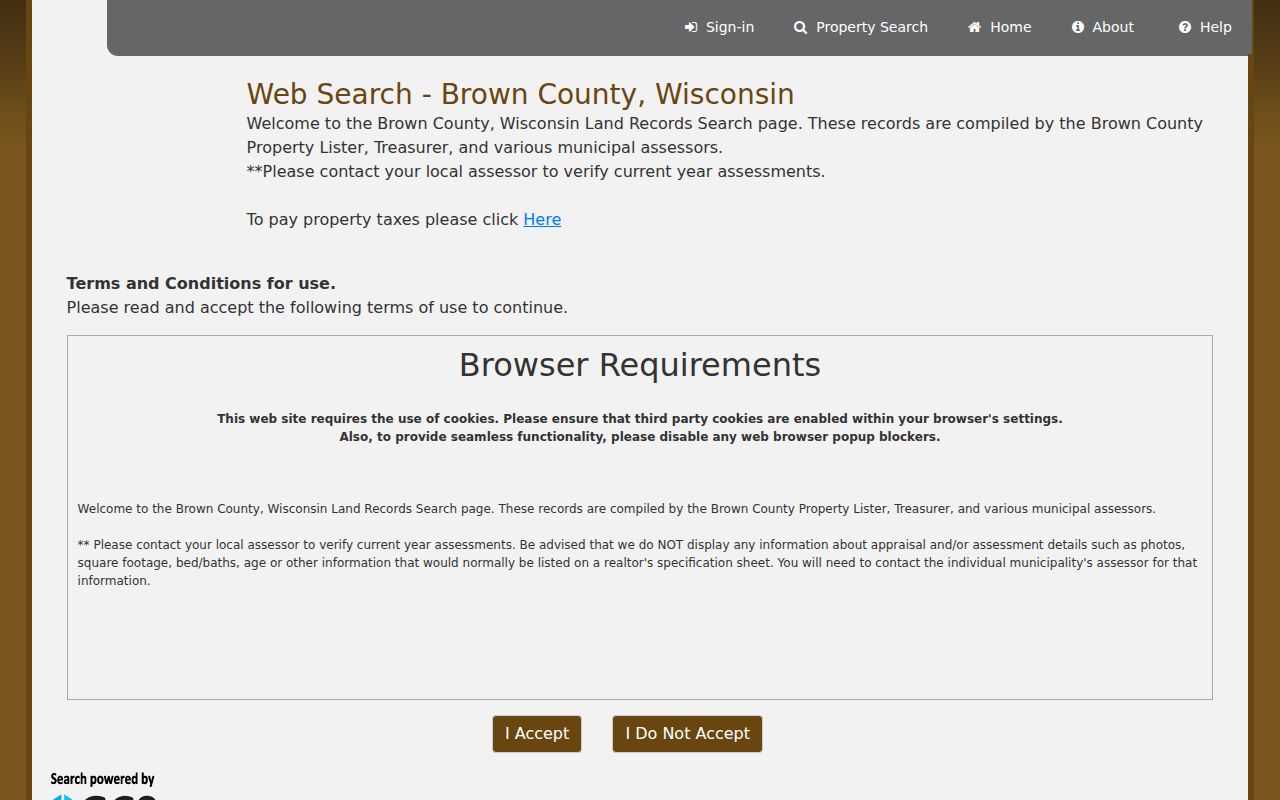
A match identifies an ownership record, not each person in the home. Move to another roll before drawing a conclusion about residence.
Green Bay Deed Index Cutoff
The Brown County Register of Deeds makes document images and its Grantor/Grantee Index available from February 1, 1962, forward through Laredo and Tapestry. Laredo serves frequent professional users, while Tapestry is the occasional, pay-as-you-go route. An in-office public terminal search is free, though printing costs apply. Land-record research at the office requires an advance appointment.
A grantor is the party transferring an interest. A grantee receives it. Search both roles because the same owner can appear on opposite sides of separate documents. Known document numbers, book and page references, recording dates, document types, and parcel or legal descriptions can narrow the index. For older deeds, use the office tract index, genealogy room, library maps, or the Area Research Center rather than assuming the online start date marks the start of county records.
Current Green Bay Resident Rolls
Modern directories of Green Bay residents are purpose-built rolls. Each names a limited class of people for a public task. The property search identifies owners connected to parcels. MyVote checks registration through details supplied by the user. The recorded-document index names parties to deeds, mortgages, plats, and other filings. City staff and neighborhood contacts are narrower public rosters. None should be treated as a master list.
| Source | Who appears | Keeper | Access |
|---|---|---|---|
| Property Search | Parcel owners | County and assessors | Free online |
| MyVote | Matching registered voters | Wisconsin elections system | Name or address check |
| Grantor/Grantee Index | Document parties | Register of Deeds | Paid web or free terminal |
| City staff directory | Municipal contacts | City of Green Bay | Free online |
Use the roll that fits the question. Ownership begins with a parcel, registration begins with MyVote, and a recorded transfer begins with the deed index. For same-name cases, the Green Bay resident lookup shows how to compare records without merging people.
MyVote Search in Green Bay
MyVote Wisconsin offers two paths. The name route asks for first name, last name, and birth date. The address route asks for street address, city, ZIP, and an optional unit. Use the name as it appears on a Wisconsin driver license or ID, and do not interpret a failed match as proof that someone does not live in Green Bay.
Wisconsin is not a party-registration state. The official list can contain a voter's name, residence address, registration status, municipality, ward, precinct, and districts. Birth dates, license numbers, Social Security numbers, and protected addresses are restricted. Some old records without a birth date may use January 1, 1900 as a default.
The official voter form shows why exact matching details matter.
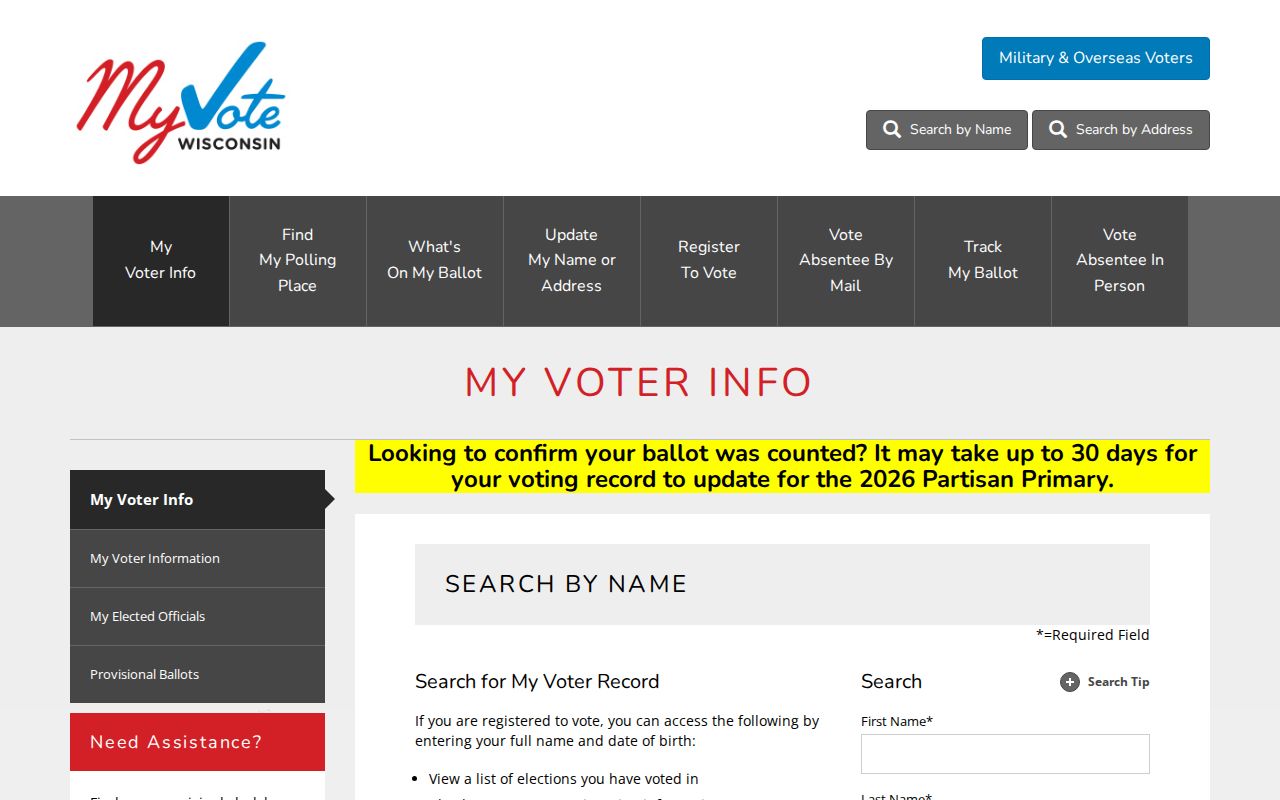
The form protects the broader voter file by requiring matching inputs, and confidential electors may not return.
Official Green Bay Rolls Compared
Official sources are narrow but easier to interpret. They identify the custodian, event, and route to the underlying file. Commercial people-finding reports combine public records and other data, which can be stale, merge same-name people, or retain an error after the source changes.
| Route | Best use | Main limit |
|---|---|---|
| Official roll | Confirm one defined fact | Limited scope |
| Custodian copy | Verify the source document | Fees or eligibility may apply |
| Commercial compilation | Generate a personal research lead | Source date may be unclear |
Opting out of a commercial report does not remove the government source. Corrections go to the office that created the record.
Green Bay Directory Terms
Public portals use short terms for different levels of proof. Keeping them separate prevents a map, search hit, or old directory line from carrying too much weight.
- Roll
- A list kept for one public purpose, such as tax assessment.
- Index
- A finding aid pointing to a document, not always the full file.
- Parcel
- A mapped tax unit whose shape is not a legal survey.
- Criss-cross directory
- A volume arranged by street and house number.
- Certified copy
- A copy authenticated by its custodian.
BrownDog illustrates the distinction. Its LegalLabel may point to the document that shaped a parcel, while a related DocID can identify a newer filing. The recorded deed controls the legal chain.
Green Bay Court Name Checks
Wisconsin Circuit Court Access publishes case summaries that may distinguish people with the same name. A hit can show party, county, case number, type, filing date, status, events, and disposition. It remains an index. Sealed, expunged, juvenile, and certain paternity records do not appear online.
The Brown County Clerk of Circuit Court keeps files at 100 S. Jefferson Street. Lobby computers can search electronic records, while requests may arrive in person, by mail, phone, fax, or email. Online viewing reaches 1990, and older files may be off-site. Copies cost $1.25 per page, certification adds $5 per document, and a search without a case number costs $5.
Green Bay municipal ordinance cases use a separate public inquiry and should not be confused with circuit cases.
Green Bay Offline Record Routes
An online gap calls for another channel. The Register of Deeds has an appointment-only search room, public terminal, mail requests, copy service, and paid web access. The circuit clerk accepts several request methods. Brown County Library and UW-Green Bay archives bridge older gaps with shelves, microfilm, maps, and original files.
Wisconsin Public Records Law, Wis. Stat. §§ 19.31-19.39, permits a request for identifiable records held by the responsible authority. State a name, address, record type, and useful date range. Ask for segregable public portions when part is confidential. There is no fixed statewide deadline; the authority must respond as soon as practicable and without delay.
The County Clerk does not hold circuit files, and the assessor does not certify deeds. Direct each request to the right custodian.
Green Bay Vital Record Links
Birth, death, marriage, and divorce certificates can confirm family ties, former names, and event dates, but they are not an open resident roll. The Brown County Register of Deeds issues eligible records at its Green Bay counter. Wisconsin also provides mail, web, and phone ordering through the Department of Health Services. The state counter is closed, so do not plan a Madison walk-in visit.
Statewide issuance depends on the record type and date. Brown County lists statewide birth records from October 1, 1907, death records from September 1, 2013, marriage records from October 1, 1907, and divorce records from January 1, 2016. Direct-and-tangible-interest rules govern certified copies under Wis. Stat. chapter 69. Older genealogy searches use a different path through in-person records, microfiche, the library, the Wisconsin Historical Society, and the Area Research Center.
Wisconsin vital-record applications separate the forms by event. Read the current identification, eligibility, and delivery instructions before ordering. An index entry helps identify a record, while only the custodian can issue the certified copy.
Historic Green Bay Residents Directory
Brown County Library holds Green Bay and Brown County directories, some dating from the 1870s. Its Local History and Genealogy collection includes more than 10,000 print volumes and 4,400 microfilm reels. The exact year and publisher run is not listed online, so ask staff or check the catalog rather than assuming each year survives.
A city directory may give a name, spouse or widow notation, occupation, employer, address, and business listing. Reverse sections begin with the street. The Green Bay city directory guide explains how to pair entries with census years and newspapers. Cemetery cards, historic vital indexes, plats, and Sanborn maps add context.
The library collection page leads to staff help and the historical shelf.
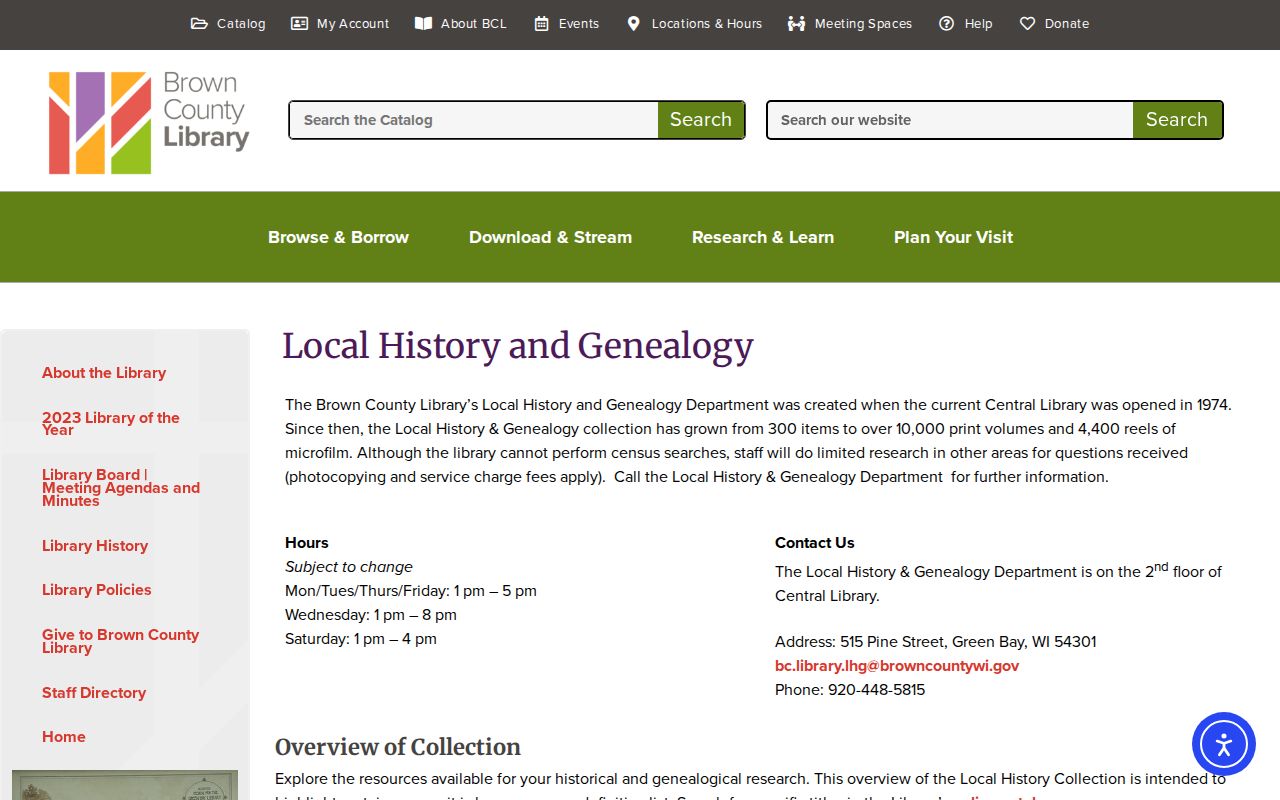
This collection reaches beyond the modern online cutoff and helps separate former residents from current owners.
Green Bay Family Search Paths
Some resident searches begin with a relationship instead of an address. Brown County probate files can name a personal representative, heirs, or other parties connected with an estate. WCCA may supply a case number, but older probate material often requires the Register in Probate, the local file, or the UW-Green Bay Area Research Center. The ARC partial index includes Brown County wills and probate case files from 1821 through 1976, along with citizenship records from 1829 through 1984.
The UW-Green Bay Archives search accepts first and last name, county, collection, Soundex, keywords, case type, corporate name, and role type. Results point to records rather than full online images. Copy requests cost $10 for retrieval and up to 20 pages, with extra pages at $0.50 each. The stated wait is six to eight weeks, so record the collection and result details before requesting material.
Other family paths have their own official route. An adult adoptee may use Wisconsin's Adoption Records Search Program for eligible information, including a birth-parent contact search under program rules. An heir can combine probate with deeds and Wisconsin unclaimed property. Former classmates may appear in Brown County Library yearbooks, school annuals, and newspapers. Each trail needs independent identity checks because a shared surname alone does not prove a family link.
The library's deep newspaper run can resolve moves, marriages, deaths, and estate notices. Green Bay Gazette variants extend back to 1870, the Press-Gazette begins in 1915, and Brown County community newspaper microfilm reaches 1833. Subject card files cover only defined periods and are not vital-record indexes.
Green Bay Records Changed Places
Brown County was created in 1818. Green Bay became a city in 1854, when voters also moved the county seat from De Pere. Fort Howard joined Green Bay in 1895, and Preble consolidated with the city in 1964. An address may appear under a former community, ward, plat, or directory heading.
Digital systems also moved. Brown County adopted GCS LandNav in May 2019. The Register of Deeds web coverage begins in 1962. In 2026, the Land Information Office said older maps and apps were being retired or condensed into BrownDog2.0. Save the parcel, legal description, document number, and custodian name rather than only a bookmark.
Search Fort Howard, Preble, or an older plat before deciding that a Green Bay resident record is gone.