
Green Bay Directory Shelves
The best-documented local starting point is Brown County Library’s Local History and Genealogy Department. Its collection explicitly includes Green Bay and Brown County city directories, some dating from the 1870s. UWGB Archives holds city directories and many related local records. Wisconsin Historical Society supplies catalog and digital routes. No official source reviewed gave a complete year-by-year publisher run, so availability should be checked before a visit.
| Collection | Years | Where Held | Access |
|---|---|---|---|
| Green Bay and Brown County city directories | Some from the 1870s; exact run not published | Brown County Library; UWGB catalog | Library shelf, catalog, or archive inquiry |
| Reverse and address sections | Edition-specific; exact run not published | Library and UWGB holdings | Inspect each available volume |
| Green Bay and Fort Howard directory | 1894-95 | Wisconsin Historical Society digital object | Free online item record and scan |
| Newspapers and subject indexes | Community film from 1833; Green Bay runs from 1870 | Brown County Library and databases | In person, library card, or digital |
A missing year is not proof that no directory was printed. It may reflect an incomplete shelf, catalog wording, or a publisher gap. Ask for the exact year and format, then record the title page and abbreviation key with each entry.
Green Bay Library Directory Room
The Brown County Library Local History and Genealogy Department is on the second floor of Central Library, 515 Pine Street. Its direct phone is 920-448-5815 and email is bc.library.lhg@browncountywi.gov. Hours are 1 to 5 p.m. Monday, Tuesday, Thursday, and Friday; 1 to 8 p.m. Wednesday; and 1 to 4 p.m. Saturday.
The department grew from 300 items when it began in 1974 to more than 10,000 print volumes and 4,400 microfilm reels. That scale matters because a Green Bay city directory search often needs a newspaper, cemetery card, vital microfiche, plat, or map beside the directory. Staff can do limited research other than census searches for service and copy charges.
The library’s official page introduces the collection and access choices.
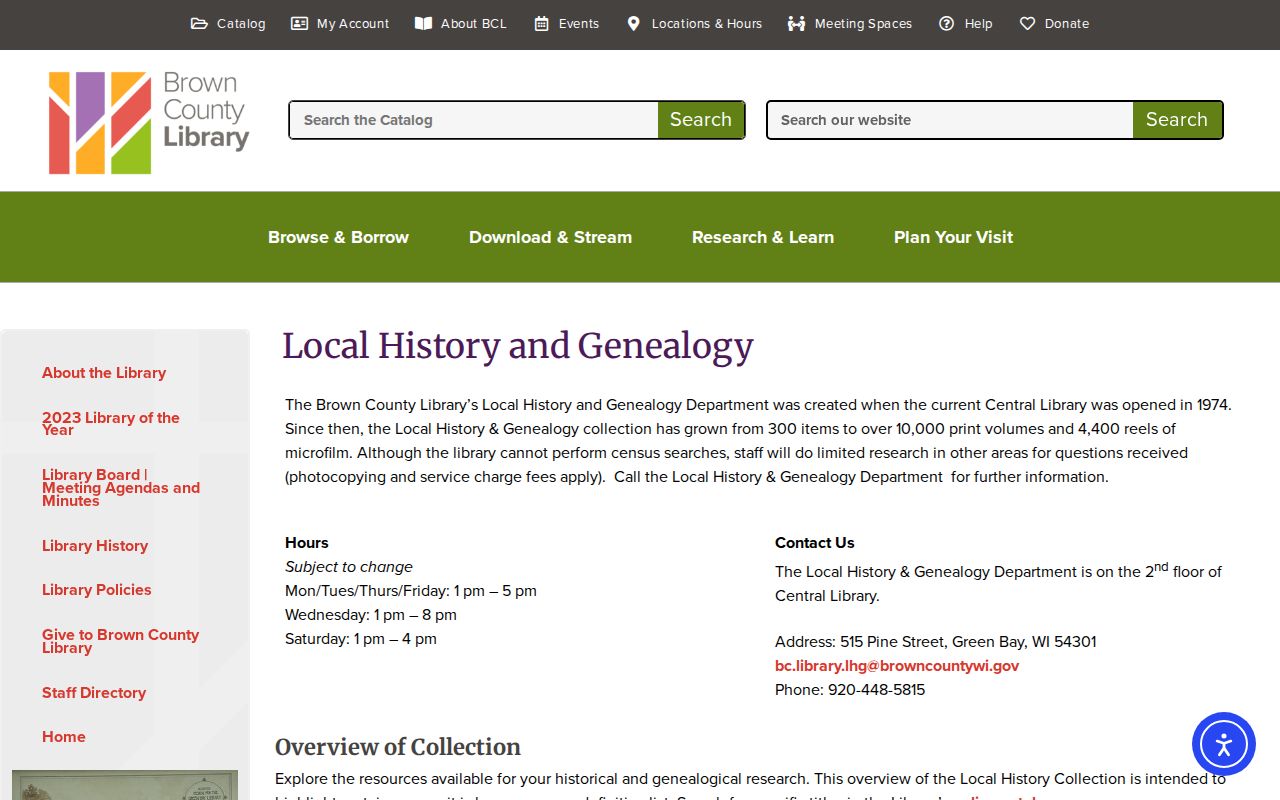
The captured page confirms that the directory shelf belongs to a much broader set of Green Bay and Brown County finding aids.
Green Bay Directories at UWGB
The UW-Green Bay Archives and Area Research Center is in the Cofrin Library at 2420 Nicolet Drive. It holds non-circulating city directories, local histories, maps, Sanborn fire-insurance maps, cemetery plats, photographs, and files on people and buildings. Original records can include tax, election, land, probate, school, court, citizenship, and municipal material from Brown County.
Its online name search is partial, not a scan of every directory. Fields include first and last name, county, collection, Soundex, keyword, case type, corporate name, and role. Results list names, year, collection, record type, county, and information. Copies cost $10 for retrieval and up to 20 pages, with extra pages at 50 cents; the stated wait is six to eight weeks.
The archives page shows the range that can extend a city directory result.
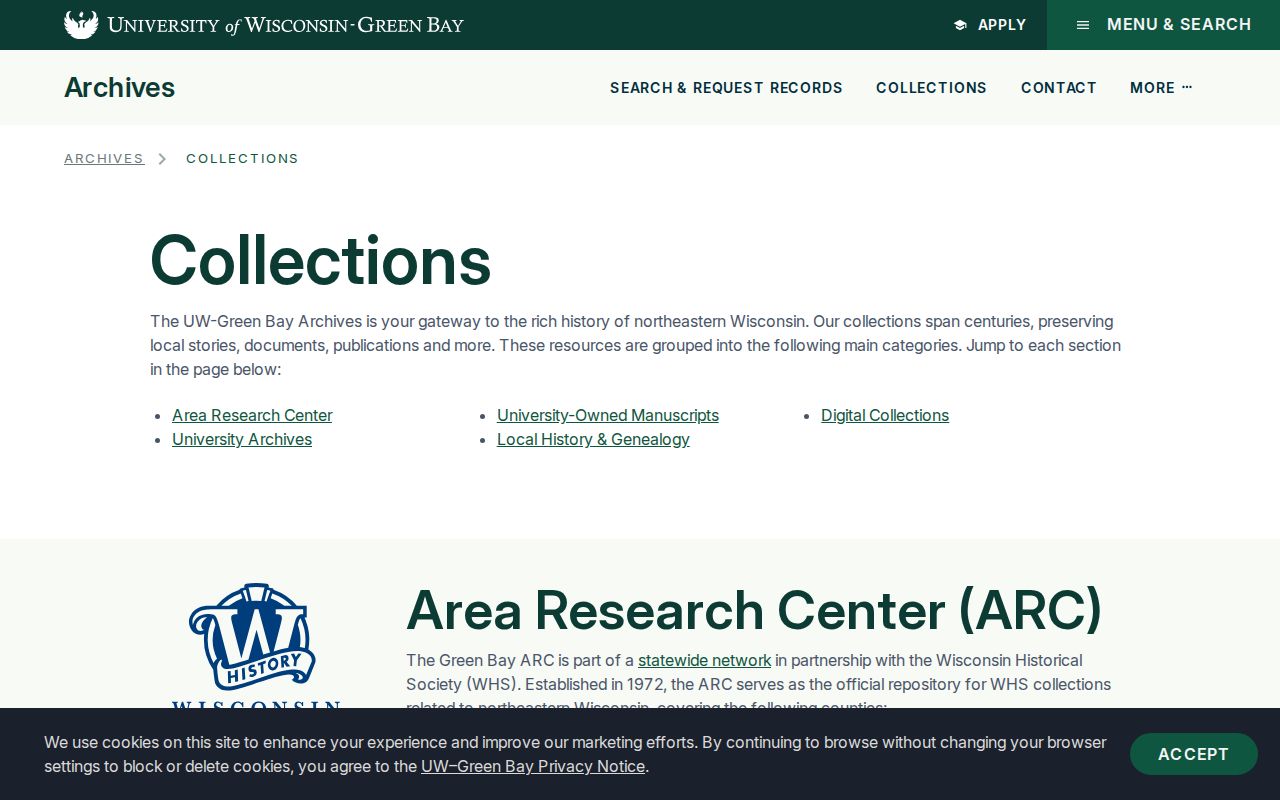
A name can be tested against probate, citizenship, tax, or municipal records without assuming that the partial web index contains every holding.
A Green Bay Directory Online
Wisconsin Historical Society identifies a digitized Wright’s directory of Green Bay and Fort Howard for 1894-95, a 294-page volume. This item is useful because the title preserves Fort Howard just before its 1895 annexation into Green Bay. Read the scan’s title page, contents, and key before interpreting a short listing.
The society’s 1894-95 Green Bay and Fort Howard directory record is an item-level route. Broader catalog searches can use Green Bay, Brown County, Fort Howard, publisher, and year terms. One online object is not proof of a complete digitized run.
Green Bay Directory Research Network
The Brown County Historical Society’s resources page connects researchers to UWGB Archives, Brown County Library, Wisconsin Historical Society, Heritage Hill, Neville Public Museum, the National Railroad Museum, the Green Bay-De Pere Antiquarian Society, and local historical groups. These repositories do not share one combined resident index. Each can hold different context, including photographs, business files, maps, family papers, or community publications.
Use the Brown County Historical Society repository list when a directory entry points to an institution, neighborhood, railroad, or firm.
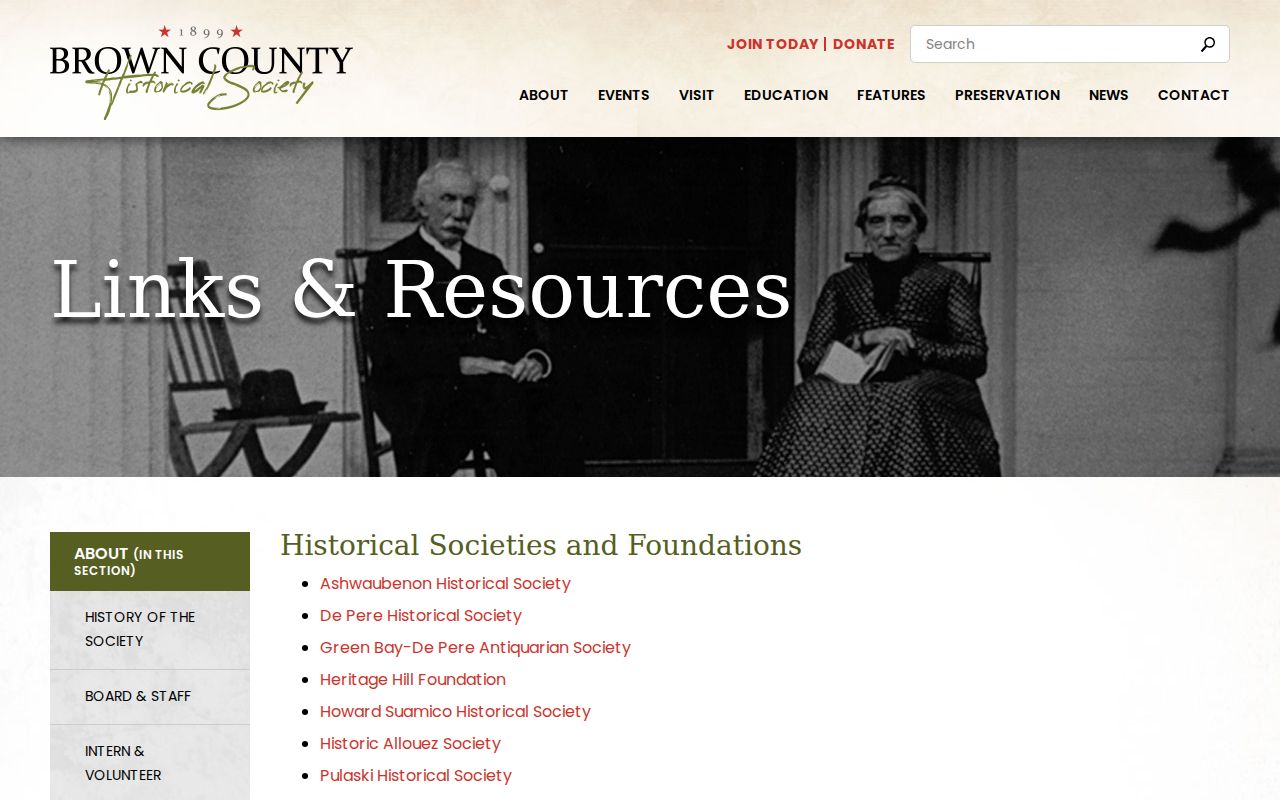
The network view routes a narrow question to the collection most likely to preserve its answer, while the directory remains the dated starting citation.
Read Green Bay Directory Entries
A city directory entry must be read with its edition’s key. Common fields include a person’s printed name, spouse or widow notation, work or business, and a numbered street address. Some editions use letters such as “r” or “h,” apartment distinctions, or marks tied to an owner or renter, but no single key applies to every Green Bay publisher or year.
| Name | Printed surname, given name or initials; spouse may appear in parentheses. |
|---|---|
| Work | Occupation, business, or employer when the edition includes it. |
| Address | House number, street, and sometimes an apartment or unit. |
| Residence mark | An edition-specific letter or symbol defined by that book’s key. |
| Widow notation | A relationship clue that may name a deceased spouse. |
- Criss-cross directory
- An address section arranged by street and house number, useful when the surname is unknown.
- Householder index
- A name or address list focused on the person associated with a household listing.
- Abbreviation key
- The edition’s guide to shortened terms and marks; save it before transcribing entries.
The inspected digital object did not expose a stable person-entry image or local key. Field types are safer than an invented sample line. Copy only the short line needed and cite the edition and page.
Green Bay Directory Newspaper Clues
Green Bay Gazette title variants run digitally from 1870 through June 1915, while the Press-Gazette begins in January 1915 and reaches close to the present on the library’s described access. The Advocate covers 1877 to 1885, and Brown County community newspaper microfilm begins as early as 1833. Notices may confirm a death, move, firm, address, or family tie between city directory editions.
Two aids require care. The Press-Gazette and News-Chronicle card file for 1962 to 1983 and the subject index from July 1985 through 1996 are subject indexes, not full vital-record indexes. A missing card does not mean an event was never printed. Search the paper itself by date and variant spelling.
Other library aids can test the same identity. The Green Bay Health Department marriage and death card index covers 1920 through August 1, 1986. Cemetery surname cards, pre-1907 Wisconsin vital microfiche, Wisconsin Necrology, and later state death, marriage, and divorce indexes may supply a date or relationship. These are finding aids, not certified records. Cite the index consulted, then request an original or official copy from the proper custodian when the distinction matters.
Map Green Bay Directory Addresses
Library and UWGB plat and Sanborn sources explain an old address. Plat holdings include an 1875 wall map and maps from 1889, 1900, 1928, and 1936. Green Bay and De Pere Sanborn editions span the 1880s through the 1960s in bound or microfilm form. Sanborn sheets can show footprint, use, stories, walls, windows, and materials, but not a complete resident list.
Fort Howard’s 1895 annexation and Preble’s 1964 consolidation affect place labels. Compare the directory preface, map sheet, parcel description, and modern street layer before deciding that two similar addresses are one property.
Green Bay Directory Timeline
The local record trail changed by collection and custodian. These milestones explain why names appear in one format but not another.
| 1870s | Brown County Library confirms some Green Bay and county directories date from this decade. |
|---|---|
| 1894-95 | Wright’s Green Bay and Fort Howard directory survives digitally. |
| 1895 | Fort Howard was annexed into Green Bay, changing later labels. |
| 1974 | The Central Library local-history department began with 300 items. |
| Today | The collection exceeds 10,000 print volumes and 4,400 microfilm reels. |
A first directory year, final printed year, and full publisher sequence were not established by the official pages reviewed. These are known landmarks, not a complete publication history.
Trace Families in Green Bay Directories
City directories can fill the years between census schedules. Begin from a confirmed person or property and log each edition separately. Green Bay’s historic mix of Fort Howard, Navarino, Astor, and later Preble makes the place label as important as the surname.
- Find the first known name or address in an available edition and save its full citation.
- Move through nearby years, noting spelling, initials, spouse, widow marks, work, unit, and each address change.
- Check the street-order section to see the address in context, then return to the alphabetical listing.
- Compare the 1900 through 1950 federal census years where relevant under the 72-year release rule.
- Use newspapers, cemetery cards, vital indexes, deeds, or probate to explain a disappearance or family change.
Absence may mean a move, death, missed publication, rural exclusion, changed name, or choice not to list. A directory alone cannot choose among them. For a modern trail, use the Green Bay street directory and county parcel records.