
Green Bay Neighbor Record Sources
A block lookup works best when each source has one role. BrownDog draws the parcels around an anchor address. Brown County Property Search supplies tax and owner details for each parcel. Public voter-list access may add registered names and addresses, but it is governed by state restrictions and is not the same as the personal MyVote address tool. Green Bay’s neighborhood network adds public association contacts rather than a private household roster.
| Block source | What it can establish | How Green Bay residents access it |
|---|---|---|
| BrownDog GIS | Parcel shapes, addresses, legal labels, districts, and related document links | Free advisory map; search and click parcels |
| Brown County Property Search | Owner, situs and mailing details, municipality, land class, acreage, value, and tax fields | Free online address or parcel search; local assessor verifies current assessments |
| Wisconsin voter registration list | Public name and address fields for registered voters, with protected fields removed | WEC or municipal list request under current rules; MyVote is not a neighbor roster |
| Green Bay neighborhood network | Association area, public contact, meetings, and civic activity | City association finder, organization contacts, and public meetings |
| Historic address directories | Past listed occupants by street and house number | Brown County Library and UWGB local-history holdings |
An owner name is not an occupant list. The owner may be a trust, business, estate, public agency, or person who receives the tax bill elsewhere. One parcel can also carry several units or addresses. Use the physical, or situs, address to locate the land, and treat the mailing address only as a clue about the owner or tax contact.
Map Green Bay Neighbor Parcels
Use BrownDog to move from one address to the immediate block. The map is advisory, not a survey. It can still show parcel polygons, address labels, legal references, zoning, flood areas, municipal lines, wards, polling places, school areas, sanitary districts, and aerial layers. Zoom close enough to distinguish touching lots from rights-of-way, condominium stacks, gaps, and overlaps.
- Search the anchor address and record its ParcelID, legal label, map area, and linked parcel report.
- Click each touching parcel and the parcels across the street or alley. Note every parcel ID before opening owner details.
- Use the viewer’s query, measure, or distance tools where available to check a small radius. The county layer supports distance queries, though the current button label was not exposed in static research.
- Compare each map result with Brown County Property Search. Keep the situs address apart from the owner’s mailing address.
- Follow a document link into the Register of Deeds only when ownership history matters. Do not turn the parcel list into a list of private household members.
The LegalLabel field may point to the document that created or changed the parcel shape rather than the latest deed. Use the related DocID when seeking the newest recorded document. If the task expands beyond the immediate block, the Green Bay street directory explains the full street-by-street chain.
Two Green Bay Map Views
BrownDog and Property Search are complementary tools. The property portal is stronger for owner, tax, acreage, value, municipality, and district fields. BrownDog is stronger for spatial context and for seeing which polygons actually surround the address. Neither tool proves that the owner lives there. The county portal also warns that it does not show appraisal details such as photos, square footage, bedroom or bath counts, age, or real-estate listing specifications.
The county Land Information Office reported a 2026 transition in which many older map applications were taken offline or folded toward BrownDog 2.0. Use the current LIO gateway when an old bookmark fails. Parcel and address ArcGIS services can also preserve the data trail during an interface change.
Note: A parcel polygon can split or merge while a legal lot stays the same, so compare the map with the recorded plat or survey.
Green Bay Voter Block Limits
Wisconsin Statute section 6.36 makes registration lists available electronically, including public name and address fields. Date of birth, driver-license number, Social Security number, accommodation indicators, and protected information are restricted. A lawful block-level list must come through the Wisconsin Elections Commission or the proper municipal custodian under the current fee and use rules.
MyVote Wisconsin is built for an individual voter or an address. Its address route returns polling place, ballot, and election information. It does not reveal every registered person next door. Participation history also does not disclose a ballot choice. Safe at Home and protected-elector rules create intentional gaps, so a missing name cannot be treated as proof that nobody lives at an address.
Ward and polling-place layers still add useful civic context. BrownDog can place nearby parcels in municipal, school, sanitary, and election districts without naming the people inside each home. If a formal voter-list request is needed, describe the municipality, ward, street range, and desired public fields to the proper custodian. Wisconsin Public Records Law requires a response as soon as practicable and without delay, but it sets no fixed statewide number of days.
Green Bay Neighborhood Contacts
Green Bay reports more than 40 established neighborhood associations and watches. The count changes as groups form, so the city’s current list is the safer source. The Find My Neighborhood Association tool accepts an address and returns its association. Recognized groups have defined boundaries, open membership within the area, a shared purpose, public meetings, an elected board, and a contact person.
Green Bay Neighborhoods
Citywide umbrella and liaison for recognized groups. Public contact: info@gbneighborhoods.org or 920-593-3716. No universal member roster is advertised.
City Association Finder
Matches a Green Bay street address to a recognized association. It identifies the civic group, not every resident within its border.
Neighborhood Watches
The city connects residents with local safety and community channels. A public citywide roster of watch participants was not located.
Associations may post newsletters, host public meetings and block events, clean parks, study traffic, or discuss planning matters. Those contacts are useful for a respectful introduction. Downtown, Broadway, Olde Main, Military, University, and Velp organizations may describe a district, but a district group is not automatically a household association.
Astor Neighborhood Association appears in the county historical-resource network, while Green Bay Neighborhood Leadership Council links association presidents, city staff, and community leaders at the citywide level. Churches, civic clubs, school areas, and block-watch coordinators can add public points of contact, but no complete congregation or watch-member roster was found. Ask for a public contact or meeting date, not a private list.
The manifest captured the city’s association and watch page. Open the official neighborhood page for its current list and programs.
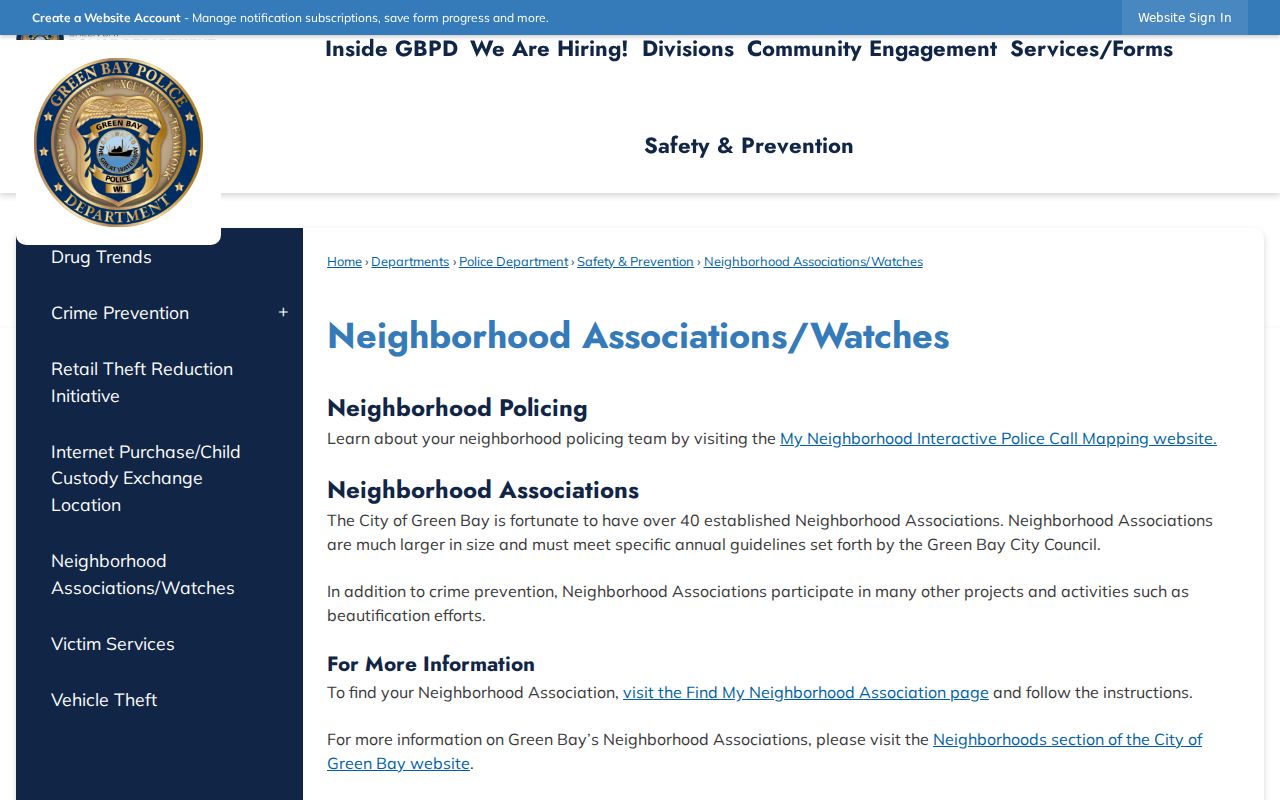
The page supplies a community connection layer without claiming that association contacts form a resident directory.
Green Bay Neighbor Tool Check
Official rolls and commercial neighbor tools answer different questions. County and city sources state what office created the record and how to correct or verify it. Commercial services can merge public, marketing, and address data without showing the source clearly. A familiar name or polished profile is not proof of present occupancy.
| Source type | Best use | Main limit |
|---|---|---|
| County parcel and tax record | Confirm a parcel and recorded owner | Owner may not occupy the property |
| Official voter list | Confirm public registration fields under state law | Protected residents and nonvoters are absent |
| Neighborhood association | Find public civic contacts and meetings | No citywide private member directory is advertised |
| Commercial compilation | Possible starting clue | May be stale, merged, or detached from an official record |
Verify a claim with the office that holds it. Utility accounts, delivery records, and driver-address data are not public neighborhood rolls.
Protect Green Bay Neighbors
Wisconsin’s Safe at Home program under section 165.68 gives qualifying people a substitute address for public and private business. Once an authority is notified, it must not release an actual home, work, or school address without a court order. Confidential-elector rules and court address-removal procedures offer other protections. Those safeguards are designed to make some searches fail.
A block record also leaves ordinary gaps. Renters and household members do not appear merely because a parcel has an owner. Private association membership, congregation rolls, watch contacts, utility customer data, and delivery accounts are not public resident lists. Respect a person who does not choose to make contact, and use public group meetings or public association channels for neighborhood questions.
Lawful use. Check Green Bay neighbors for civic curiosity, reconnection, or personal safety awareness. Never use records to watch, intimidate, stalk, or harass another person.